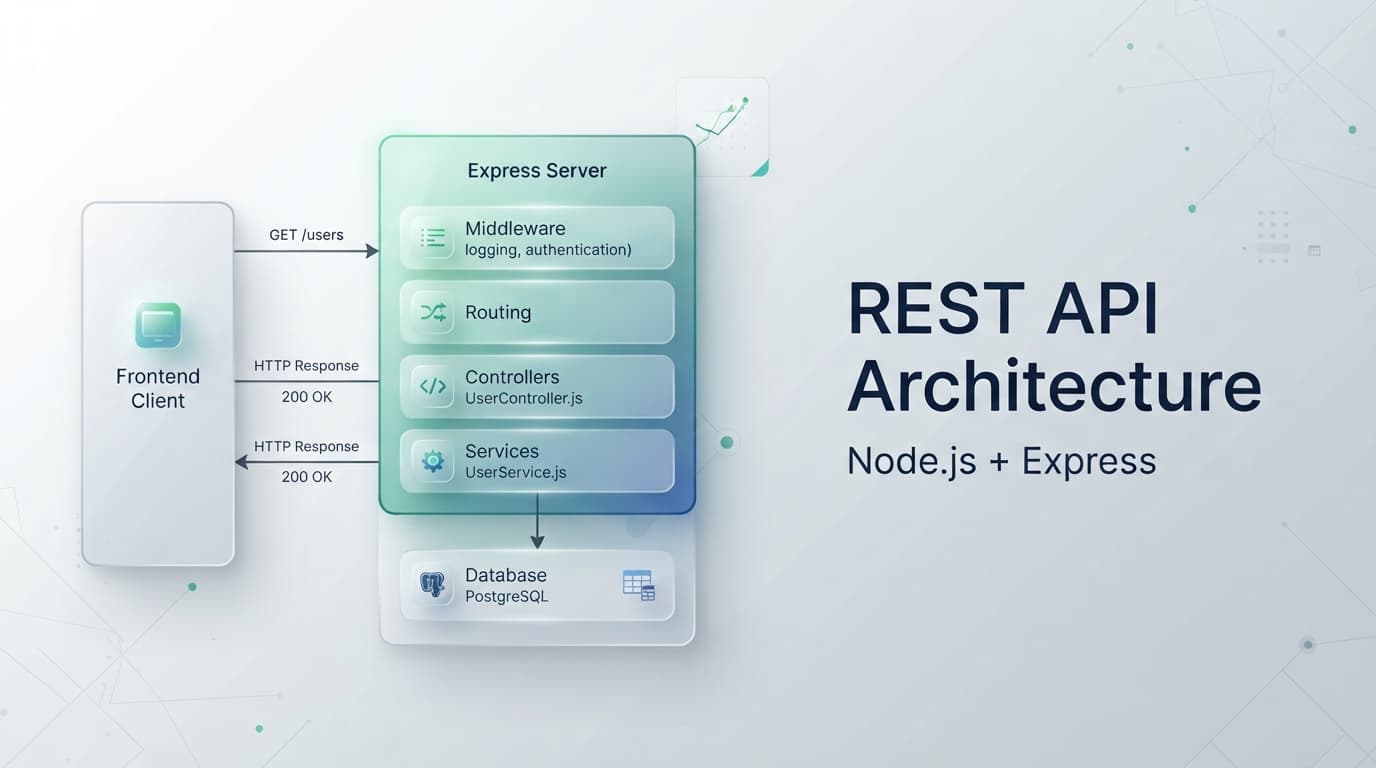
Designing a Clean REST API with Node.js and Express
Learn how to organize a Node.js and Express backend using controllers, services, middleware, validation, authentication, and consistent API responses.
Written byMonir Hossain
Aug 19, 2026
4 min read
A well-designed API is one of the most important foundations of a modern web application.
Whether the frontend is built with React, Next.js, Vue, Angular, or another framework, the frontend still needs a reliable way to communicate with the backend.
The API sits between the user interface and the application's data and business logic.
                    Frontend
                       |
          +------------+------------+
          |                         |
          v                         v
       React                     Next.js
          |                         |
          +------------+------------+
                       |
                       v
                  REST API
                       |
             +---------+---------+
             |                   |
             v                   v
        Business Logic       Database
Node.js and Express provide a lightweight and flexible foundation for building these APIs.
Creating endpoints, however, is only the beginning.
As an application grows, the backend needs a structure that keeps responsibilities separated, makes business logic easier to test, and allows new features to be added without turning the codebase into a collection of tightly coupled route handlers.
In this article, we'll look at the fundamentals of REST APIs and how to build a maintainable backend architecture with Node.js and Express.
1. What Is a REST API?
REST stands for Representational State Transfer.
It is an architectural style for designing networked applications, particularly APIs that communicate over HTTP.
Instead of thinking about endpoints as actions such as:
Then the service doesn't need to know every detail of the underlying database query.
Service
   |
   v
Repository
   |
   v
Prisma
   |
   v
PostgreSQL
For small applications, adding a repository layer may be unnecessary abstraction. The important point is to keep persistence concerns from spreading throughout the entire codebase.
10. Feature-Based Project Structure
As applications become larger, organizing files by feature can often be more maintainable than having one giant folder for every technical layer.
This keeps everything related to a feature close together.
For a large application, finding all the code associated with products is often easier than searching through separate global controllers, services, and repositories folders.
11. Middleware
Middleware is one of Express's most powerful features.
A middleware function sits in the request pipeline.
Conceptually:
Request
   |
   v
Middleware
   |
   v
Middleware
   |
   v
Controller
   |
   v
Response
Middleware is useful for cross-cutting concerns such as:
Authentication
Authorization
Logging
Validation
CORS
Request parsing
Rate limiting
Error handling
For example:
app.use(express.json());
This parses incoming JSON request bodies.
12. Authentication Middleware
Authentication is a common use case for middleware.
The important thing is to establish a predictable contract and follow it consistently.
17. HTTP Status Codes Matter
A good API should use HTTP status codes meaningfully.
Some common examples:
200 OK
    Successful request

201 Created
    Resource successfully created

204 No Content
    Successful request with no response body

400 Bad Request
    Invalid client input

401 Unauthorized
    Authentication is missing or invalid

403 Forbidden
    Authenticated user lacks permission

404 Not Found
    Resource does not exist

409 Conflict
    Request conflicts with current state

422 Unprocessable Content
    Request is syntactically valid but semantically invalid

500 Internal Server Error
    Unexpected server-side failure
Correct status codes make APIs easier to consume and debug.
18. Centralized Error Handling
Errors are inevitable.
The important question is how your API handles them.
Instead of writing error-response logic separately in every controller:
But exposing internal stack traces to users can reveal unnecessary information about your system.
A production API should generally return a safe message:
{
  "success": false,
  "message": "Internal server error"
}
while logging the detailed technical information internally.
This creates a separation between:
Internal Logs
     ↓
Detailed Diagnostics
and:
API Response
     ↓
Safe Client Information
20. Authentication Strategy
There isn't one universal authentication mechanism.
Depending on the application, you might use:
Cookie-based sessions
Access tokens
Refresh tokens
OAuth
OpenID Connect
API keys
For example, a token-based architecture might look like:
Login
  |
  v
Credentials Verified
  |
  v
Access Token
  |
  v
Protected API Request
  |
  v
Authentication Middleware
  |
  v
Controller
The important thing isn't simply choosing a popular authentication method.
You should consider:
Security requirements
Browser vs mobile clients
Token lifetime
Session management
Revocation requirements
Storage strategy
Refresh mechanisms
Authentication is an architectural decision, not just a middleware function.
21. Rate Limiting
Public APIs should also consider abuse and excessive traffic.
A simple architecture is:
Client
  |
  v
Rate Limiter
  |
  +---- Limit exceeded → 429
  |
  +---- Allowed
          |
          v
       API
A client that sends too many requests might receive:
429 Too Many Requests
Rate limiting can help protect:
Login endpoints
Password reset
Public APIs
Search endpoints
Expensive operations
In distributed deployments, the rate-limit state often needs to be stored in a shared system such as Redis rather than only in the memory of one application server.
22. Logging and Observability
A production API needs more than console.log().
You should be able to answer questions such as:
What happened?
When did it happen?
Which endpoint failed?
How long did it take?
Which request caused the problem?
Which user or request was involved?
A useful request flow might look like:
Incoming Request
       |
       v
Request ID
       |
       v
API
       |
       v
Structured Logs
       |
       v
Monitoring / Observability
Structured logging becomes particularly valuable when multiple servers are running behind a load balancer.
23. API Versioning
As applications evolve, changing an API can break existing clients.
For example:
/api/v1/users
could coexist with:
/api/v2/users
Versioning strategies vary, but the underlying purpose is the same:
Allow APIs to evolve without unexpectedly breaking existing consumers.
Not every application needs multiple versions immediately.
Versioning becomes more important when an API is consumed by multiple external or independently deployed clients.
24. A Practical Express Request Flow
A well-structured backend may look like:
                 Client
                    |
                    v
              HTTP Request
                    |
                    v
               Middleware
                    |
        +-----------+-----------+
        |           |           |
     Auth        Validation   Rate Limit
        |           |           |
        +-----------+-----------+
                    |
                    v
                  Route
                    |
                    v
               Controller
                    |
                    v
                 Service
                    |
                    v
              Data Access
                    |
                    v
                Database
                    |
                    v
                Response
This separation makes the request lifecycle easier to understand and debug.
25. Example Project Structure
A practical Express + TypeScript project could look like:
A good architecture should evolve according to the application's complexity rather than following a folder structure just for the sake of following one.
26. What Makes an API Maintainable?
A maintainable API usually has several characteristics.